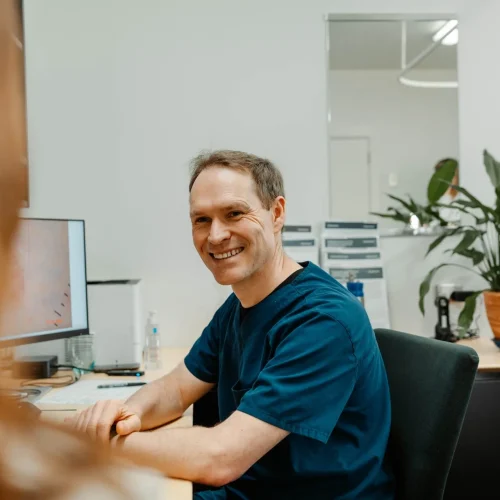
By Chris Vodde, Molecheck Skin Cancer Doctor
Artificial intelligence is reshaping many areas of medicine, and skin cancer detection is no exception. Tools such as AI image analysis and total body photography (TBP) are becoming more visible in clinics and in the media. They are powerful technologies — but their value is often not well understood..
As a skin cancer doctor, I welcome innovation. I use technology every day, and I’ve seen how much it can help. But I’ve also seen what the research consistently shows: AI and TBP, while valuable, are not replacements for a comprehensive, clinician‑led skin examination.
Across multiple studies, AI systems perform at a level similar to dermatologists when analysing single images. That sounds impressive — and it is — but a skin check is far more than an image. It is a conversation, a risk assessment, a hands‑on evaluation, and a clinical decision made in real time. AI still struggles with rare lesion types, amelanotic melanoma, and underrepresented skin tones. It cannot ask about symptoms, feel a lesion, understand a patient’s history, or decide whether something needs to be removed today or safely monitored. Patients still need a full clinical examination, and they still need a doctor to interpret what the technology shows.
This is exactly why, during a Molecheck appointment, every mole — and any lesion that could represent another form of skin cancer — is examined in person using a hand‑held dermoscope. This surface microscope reveals structures beneath the skin that no camera or algorithm can fully interpret. When a lesion needs closer monitoring, I take dermoscopic photographs of that specific mole. These permanent images become part of the patient’s record and allow precise comparison over time, helping detect subtle changes early while also preventing unnecessary surgery. This targeted, clinician guided approach improves diagnostic accuracy; combining expert assessment with selective imaging delivers the safest and most effective outcome.
AI and TBP do have a role in certain settings, particularly for high-risk patients with many moles or a history of melanoma. They offer a photographic record that can be useful for long‑term monitoring. But they also add time, cost, and complexity, because the technology does not replace the need for a clinician — it simply adds another layer for the clinician to interpret.
The most effective approach is a clinician examination supported by technology where it genuinely adds value. For most New Zealanders, a thorough doctor‑led skin check remains the most efficient and meaningful way to detect skin cancer early. Technology can help us see more, but it is the doctor who understands what it means.